ISO 639-3 · afrafr
Indo-European family
Afrikaans
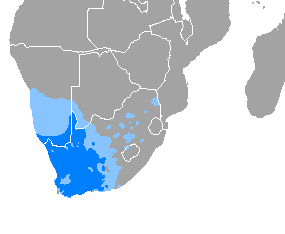
Afrikaans is a language of the Low Franconian branch (Indo-European), spoken in South Africa, Botswana, Namibia and Zambia and 1 more country. Wikidata counts about 7.2 m speakers (2016). Wikidata describes it as “West Germanic language evolved from Dutch vernacular in the 17th–18th century Dutch Cape Colony; spoken primarily in South Africa and Namibia; developed among Dutch settlers and the enslaved population, gradually diverging from Dutch”.
At a glance
- ISO 639-3
afr- ISO 639-1
af- Glottocode
afri1274- Family
- Indo-European
- EGIDS
- 1 National
- UNESCO
- Safe
- Centre point
- -32.00, 20.00
- Wikipedia
- 196 language editions
—first-language speakers
10.3 msecond-language speakers
5countries
1scripts
6levels in the tree
1EGIDS level
Facts
| Name | Afrikaans |
|---|---|
| Also called | Afrikaans language, African language |
| L2 speakers | 10,300,000 (2002) |
| All speakers | 7,200,000 (2016) |
| Written in | Latin script |
| Official in | South Africa |
Vitality
EGIDS 1 National1
Institutional. Used in government, education and media — EGIDS 0 to 4.
Other languages at this levelUNESCO: Safe
Languages at this levelfamily tree
From Indo-European to Afrikaans
The branches above Afrikaans, top to bottom. Each node counts the languages of this index that belong to it.
where it is spoken
Map and countries
A distribution map from Wikimedia Commons, as linked from Wikidata; borders of language areas are approximate.
Also spoken in South Africa
engEnglishIndo-European · 1.13 bn0 · InternationalpanPunjabiunclassified · 125 mSafetamTamilDravidian · 83 m2 · ProvincialzulZuluNiger–Congo · 27.8 m1 · NationalxhoXhosaNiger–Congo · 19.2 m1 · NationalsotSesothoNiger–Congo · 6 m1 · NationaltsnTswanaNiger–Congo · 4.5 m1 · NationalnsoNorthern SothoNiger–Congo · 4.1 m1 · NationaltsoTsongaNiger–Congo · 4 m1 · NationalslvSloveneIndo-European · 2.4 m1 · National