ISO 639-3 · szlszl
Indo-European family
Silesian
Ślůnsko godka
Silesian is a language of the Lechitic branch (Indo-European), spoken in Poland and Czech Republic. Wikidata counts 457,900 first-language speakers (2021). Wikidata describes it as “West Slavic ethnolect”.
At a glance
- ISO 639-3
szl- Glottocode
sile1253- Family
- Indo-European
- EGIDS
- 5 Developing
- Centre point
- 50.50, 18.50
- Wikipedia
- 126 language editions
457,900first-language speakers
—second-language speakers
2countries
1scripts
4levels in the tree
5EGIDS level
Facts
| Name | Silesian · Ślůnsko godka |
|---|---|
| Also called | Upper Silesian, Silesian language, Silesian dialect |
| L1 speakers | 457,900 (2021) |
| Written in | Latin script |
| Grammatical genders | 3 listed in Wikidata |
Vitality
EGIDS 5 Developing5
Stable. Spoken by all generations at home, with or without schooling — EGIDS 5 and 6a.
Other languages at this levelfamily tree
From Indo-European to Silesian
The branches above Silesian, top to bottom. Each node counts the languages of this index that belong to it.
where it is spoken
Map and countries
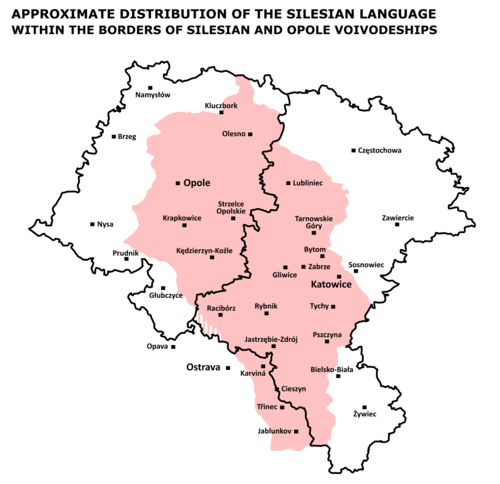
A distribution map from Wikimedia Commons, as linked from Wikidata; borders of language areas are approximate.
Also spoken in Poland
deuGermanIndo-European · 135 m1 · NationalromRomaniIndo-European · 46 mDefinitely endangeredukrUkrainianIndo-European · 34.7 m1 · NationalbelBelarusianIndo-European · 7.9 m1 · NationalhyeArmenianIndo-European · 6.7 m1 · NationallitLithuanianIndo-European · 4 m1 · NationalyidYiddishIndo-European · 1 mDefinitely endangeredrueRusynIndo-European · 610,0006a · VigorousrmyVlax RomaniIndo-European · 538,4806b · ThreatenedrmlBaltic RomaniIndo-European · 50,0005 · Developing